Welcome to PAS-AGRO-PAS
Productivity, Adaptiveness, Sustainability and Profitability of Agro-pastoral Systems in Mediterranean Countries
OBJECTIVES
The PAS-AGRO-PAS aims to increase productivity, adaptiveness, sustainability and profitability of Mediterranean agro-pastoral systems, through a systemic approach leveraged on the multifunctionality of resilient agro-pastoralism.
The systemic approach consists of a farm-to-global scale integrated evaluation interlinking agro-ecosystem, socioeconomic components and information system to identify and overcome the stressors affecting agro-pastoralists’ viability, with views to implementing strategies that redirect agro-pastoralism from fragile, subsistence-oriented systems towards resilient, climate-change adaptive, more commercially-oriented systems.
Multifunctionality alludes to the wide range of goods/services alongside food that will be addressed in this project, such as the maintenance of natural rangelands, the renewal of vegetation, the maintenance of ecological integrity, the preservation of endangered breeds, the valorisation of typical products and the quality certifications derived thereof, and the protection of tacit knowledge on the functioning of local ecosystems, flocks and rangeland management.
A network of 10 agro-pastoral systems located the Mediterranean and Atlantic biogeographical regions of Europe and in the arid and semi-arid regions of Northern Africa, will be subject of investigation for characterisation and diagnostics, design and implementation of tailored strategies, data analysis, and multi-actor knowledge exchange.
WORKPACKAGES
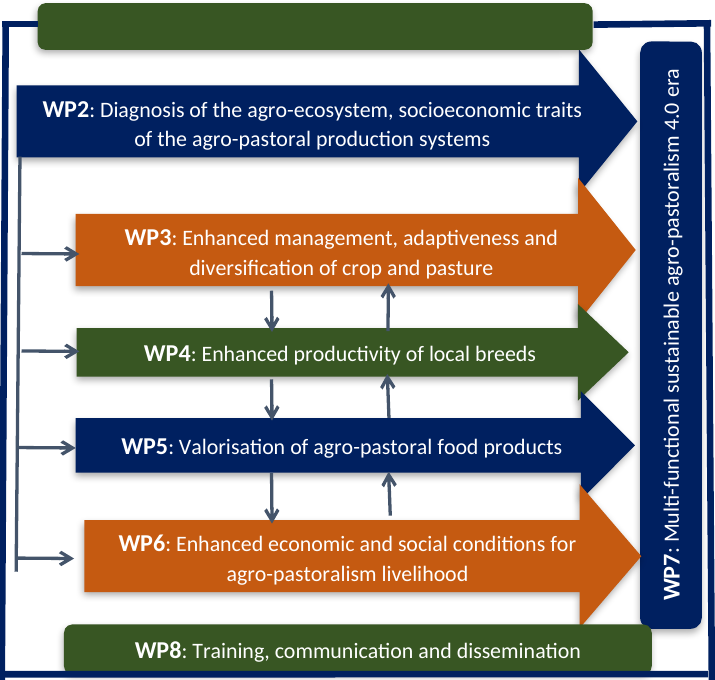
WORKPACKAGES
WP1 Management and coordination
Led by IPB aims the smooth development of the PAS-AGRO-PAS project, and to carry out the administrative and legal management and reporting of the project.
WP2 Diagnosis of the agro-ecosystem/socio-economic traits of the agro-pastoral production systems
Led by SELMET aims to propose a common framework to characterise agro-pastoral systems in the various Mediterranean locations, in terms of farming system features, traditional knowledge, socio-economical components, and agro-ecological surrounding environments.
WP3 Enhanced productivity, adaptiveness and diversification of crops, pastures, forages
Led by ECoE aims collect data on crops, forages and pastures to identify the limiting factors to their productivity and adaptiveness.
WP4 Enhanced productivity of local breeds
Led by APRI aims the benchmark the current productivity of herds/flocks of local breeds from the Mediterranean agro-pastoral systems.
WP5: Valorisation of agro-pastoral food products
Led by IPB aims to optimise the linkage between the agro-ecosystem and the socioeconomic components system, in order to increase agro-pastoralism sustainability and profitability through traditional and/or innovative quality products.
WP7: Multi-functional sustainable agro-pastoralism in the Agriculture 4.0 era
Led by IPB aims to build a centralised database where project’s results can be fed, stored, shared, analysed, and compared between partners.
WP8: Training, communication and dissemination
Led by UIZ aims to reinforce the multidisciplinary network of the Consortium members with varied scientific and technical skills by means of efficient information-flow management, interactive working mechanisms across the WPs, and technical webinars/seminars for knowledge transfer between partners.